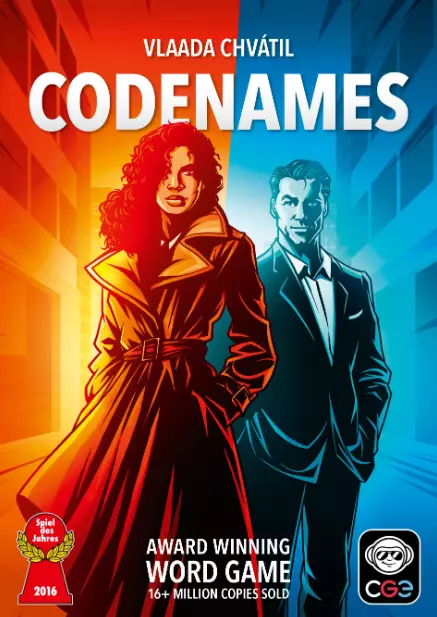
Codenames is a 2015 party board game designed by Vlaada Chvátil and published by Czech Games Edition (CGE). In it, two teams compete by each having a "spymaster" give one-word clues that can point to specific words on the board. The other players on the team must attempt to guess their team's words while avoiding the words of the other team as well as an assassin square; if the latter is selected, then the team which selected it instantly loses. Victory is achieved when one team guesses all of their spymaster's assigned words.
Codenames received positive reviews and won many awards including the 2016 Spiel des Jahres award for the best board game of the year.[2]
Rules
Codenames is a game played by 4 or more players. Players are split into two teams, red and blue. One player from each team is the spymaster; the others play as field operatives.[3][4]
During setup, 25 cards are randomly laid out in a 5x5 grid.[5] Each card has a word, and cards are face-up, so all players can see all words. But what is hidden is what each card represents: some cards represent red agents (red squares); others represent blue agents (blue squares); one represents the assassin (black square); the rest are innocent bystanders (beige squares). Spymasters get a randomly dealt key card showing the board's red/blue/black/beige colors. "Lights" on the key card represent which team will go first and have an extra agent that must be found.
Teams alternate turns. Each turn, one team's spymaster gives verbal clues to help their team's field operatives guess word squares of their team's color - while avoiding squares for opposing agents, innocent bystanders, and the assassin. The verbal clue can only manifest in the form of a single word and a number; the number refers to how many word squares should be selected in total by the field operatives for that round, while the single word (ideally) provides a thematic hint guiding the field operatives toward which word squares to select. For example, if a spymaster wants their field operatives to select the words "beach", "whale", and "water", they can give the clue "ocean 3" as these three words are all related to the ocean. The single word must be thematically related, with phonetic hints discouraged—it also cannot be or contain an existing word on the 5x5 ground. If an invalid clue is given, the turn ends immediately, and the opposing team gets to reveal one of their own agents.
After the verbal clue is given, field operatives guess which words on the board go with the clue. Spymasters use the key to cover each guessed word with red/blue/beige/black to show if the word is an agent tile, a bystander tile, or the assassin tile. Field operatives must make a minimum of one guess per turn. Once a correct guess is made, field operatives may continue to make guesses or choose to end their turn voluntarily. At most, the maximum number of guesses for a turn is the number given in the verbal clue plus one. However, if a bystander or an opposing agent is revealed, the guess is considered incorrect and the turn ends immediately. If the assassin is revealed, the game ends immediately with a loss for the guessing team.
Assuming that the assassin hasn't been revealed, the game ends once all of one team's agents are found, thus achieving victory.[6] Given the nature of the gameplay, it is entirely possible for a team to win the game during their opponents' turn. For a faster game, or in certain situations such as the opposing team taking too much time guessing, a timer, such as the hourglass timer included in the game's packaging, can be used.